









|
|
|
|
|
|
|
|
|
|
This page presents a description of the illustrations contained in the Voynich MS. A more thorough analysis should be made by competent specialists, such as historians of botany or astronomy, by paleographers, or science historians. Unfortunately, only very few comments from such experts about the Voynich MS are available.
Interpretation of the illustrations inevitably allows for a lot of well-meant speculation. It cannot be completely avoided that such speculation is also present on this page. Many online resources about the Voynich MS discuss the illustrations in the Voynich MS from different perspectives (1).
The first part of this page is organised according to the various 'sections' of the MS, as explained in the description of the manuscript:
The initial brief descriptions are expanded in a second set, including also some comparisons with other manuscripts (2).
Following that, some specific details found in the illustrations are addressed.
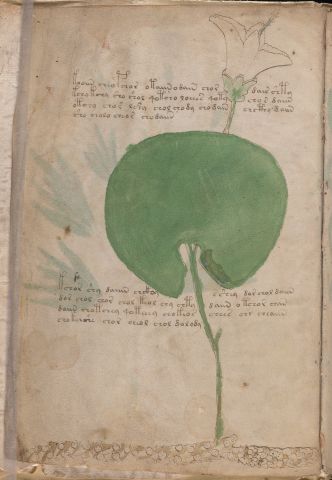
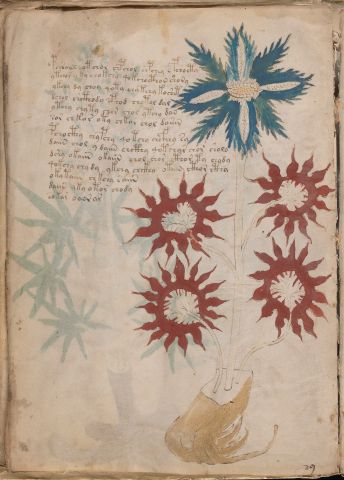
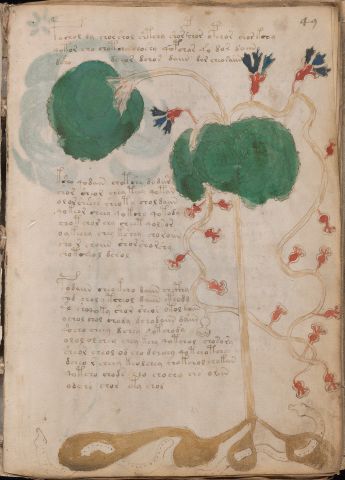
Herbal pages typically contain one, in a few cases also two, page-filling pictures of herbs with some paragraphs of text that carefully avoids the drawings.
About half the pages in the MS are of herbal nature, namely Quire 1 (except f1r which is text-only), all of Quire 2, Quire 3, Quire 4, Quire 5, Quire 6, Quire 7, f57r, f65, f66v, f87, f90 and all of Quire 17.
D'Imperio describes these drawings in Section 3.3.1
(14).
Read more here.
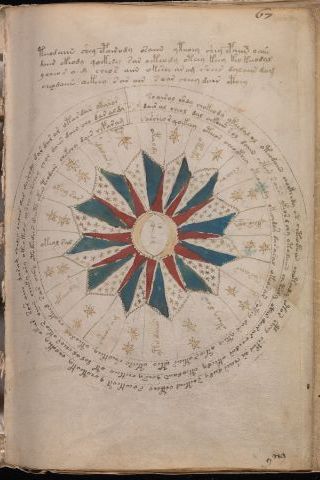
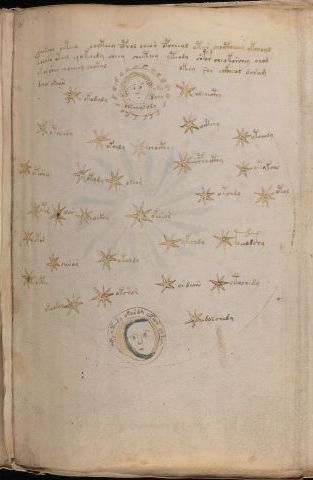
Astronomical pages feature drawings of the Sun or the Moon, or arrangements of stars. It is sometimes hard to draw a clear line between astronomical and cosmological pages (see below). The twelve astronomical pages that show illustrations of the zodiac cycle are usually called 'astrological', and are discussed separately.
The following pages are classified as astronomical: f67 and f68, except f67v2 and f68v3 (both cosmological).
D'Imperio describes the astronomical and astrological drawings in Section 3.3.3.
Read more here.
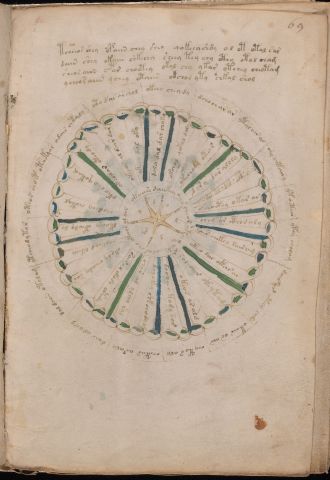
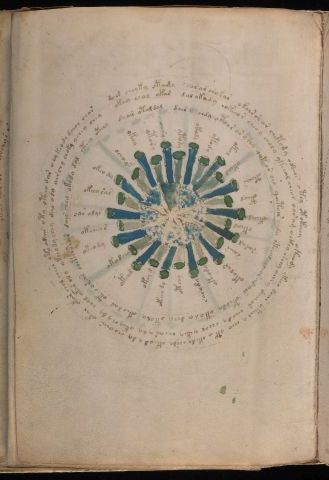
The use of the term 'cosmological' for these illustrations was first introduced in Newbold (1928) (15). Cosmological pages feature geometric designs which cannot always be easily classified. Most of them are circular, with the notable exception of a large and complicated design of nine connecting circles (also called 'network of rosettes') on a multiple fold-out sheet.
The following pages are classified as cosmological: f67v2, f68v3, f69, f70r1, f70r2, f85r2, network of rosettes, f86v4 and f86v3
D'Imperio has an extensive description of these drawings in section 3.3.4, calling them cosmological or meteorological.
Read more here.
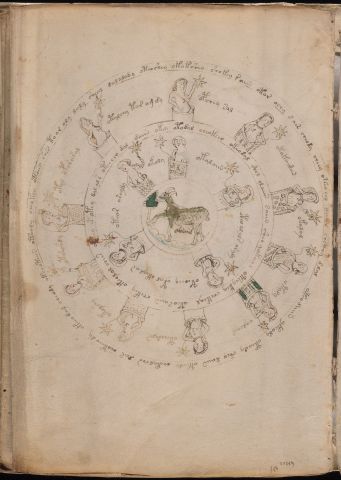
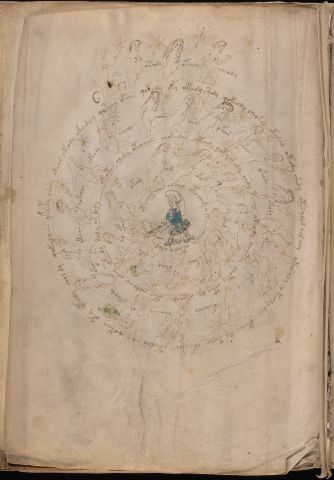
The so-called astrological pages contain concentric circles with 30 small (mostly feminine) figures holding stars, and an emblem of a zodiac sign in the centre. The human figures are very similar to those drawn in the biological section (see below).
The following pages are classified as astrological: f70v2, f70v1, f71, f72 and f73.
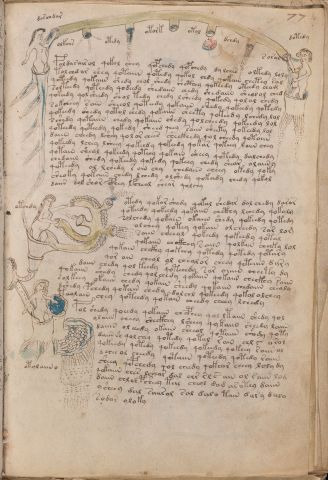
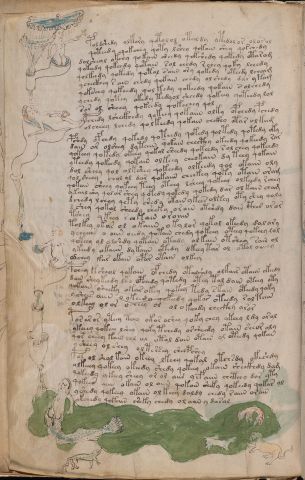
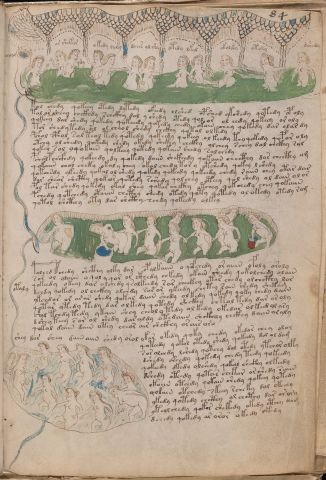
Perhaps the most unusual section of the Voynich MS is the biological section which contains drawings of human figures (mostly unclothed and mostly female) in arrangements of pipes or vessels, and pools that seem like baths or clouds. The section is also called balneological by some authors. Many illustrations leave the impression of representing a natural or (al)chemical process, including representations of human organs.
The biological section comprises the entire Quire 13.
D'Imperio describes these illustrations in Section 3.3.5.
Read more here.
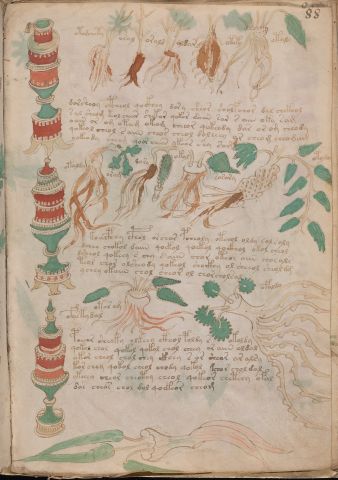
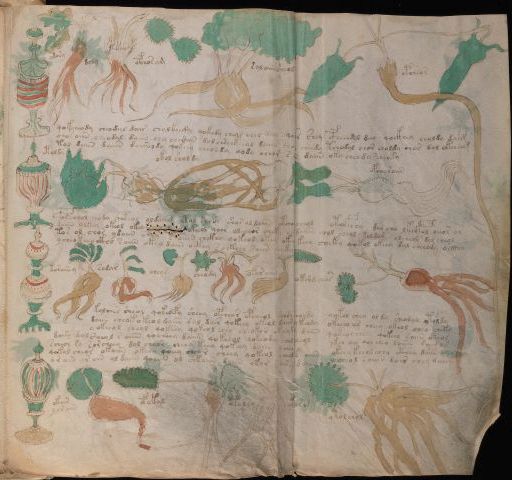
This section combines collections of apparent containers or jars, and parts of herbs, such as individual leaves and roots.
The following pages are classified as pharmaceutical: f88, f89 and all of Quire 19.
D'Imperio briefly describes these illustrations in Section 3.3.2.
Read more here.
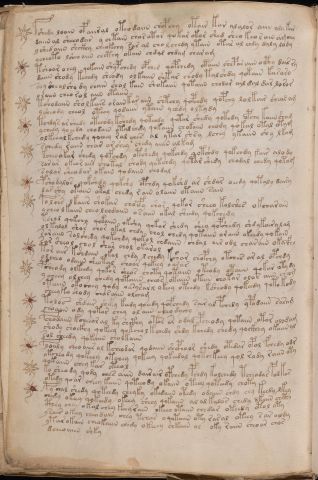
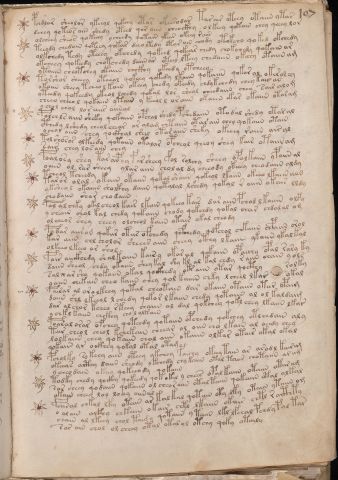
Some pages contain only text, with stars drawn in the margin. About half the stars have a red dot in the centre, or are coloured red, and many of them have a tail. This section of the manuscript is at the end, and is usually referred to as the 'recipes' section.
The following pages are text-only with marginal stars: f58 and all of Quire 20 except f116v.
D'Imperio mentions these pages in Section 3.3.7.
Read more here.
Some pages contain no illustration, but only text.
The following pages are text-only: f1r, f66r, f76r, f85r1, f86v6 and f86v5.
The herbal section of the Voynich MS covers about half the manuscript, so this topic deserves a thorough discussion. For the time being I can only present here what I derived from some of the relevant literature (3).
Herbal pages in the Voynich MS typically contain one, sometimes two, page-filling plant illustrations with some short paragraphs of text written to carefully avoid the drawings. This composition is similar to some of the herbal manuscripts produced between late antiquity and the early Renaissance. There is also a striking difference. While herbal traditions were primarily based on copying illustrations from one manuscript to another, all the way from antiquity into the 16th Century, the Voynich MS has truly unique and original drawings, and was apparently not further copied by anyone. According to Collins (2000) (4), the 15th Century, from which the Voynich MS originates, shows both trends in parallel: new and original more detailed drawings, and again a lot of copying of MSs with more abstraction. Thus, the Voynich MS is not truly unique in this sense, but fits into one movement of the 15th century.
The oldest surviving illustrated herbal manuscript is the Juliana Anicia Codex, which is a copy of the Materia Medica of Dioscurides which includes a large herbal part. It was written in the 6th century and the quality of its illustrations is remarkable, and has remained unsurpassed for many centuries. The time it was brought to Europe is after the likely creation date of the Voynich MS, so it is relatively unlikely that the author of the Voynich MS has seen it (5). The Juliana Anicia codex also has single page filling plant drawings. Later versions of Dioscorides tend to have two or more plants per page, and a page layout different from the Voynich MS. These later versions tend to be copies from each other, and in the course of the centuries the plant drawings degenerated almost into caricatures.
A second herbal tradition is most commonly known as pseudo-Apuleius, and it has generally less elaborate plant drawings than the earliest Dioscorides MSs. Again, illustrations were copied from manuscript to manuscript through the ages. By the time of the Voynich MS, they had become quite abstract, and it was usually not possible to recognise any plant just from the illustration.
During the transition from the 13th to the 14th century a new herbal tradition arose around the medical school of Salerno in S. Italy. It has become known as the Tractatus de Herbis. It featured new, original plant drawings, some based clearly on observations from nature, but in some cases also based on MS illustrations from Dioscurides or Pseudo-Apuleius. Again, this tradition was propagated by the copying of manuscripts, and two branches arose: the north Italian branch still known as the Tractatus de Herbis, and the somewhat later French branch better known as the Livre des simples Médicines.
The probable time that the Voynich MS was composed coincides with the spreading of this MS tradition. At this time, Dioscurides was still an important reference, but the pseudo-Apuleius appears to have lost popularity. It has always been stated that the Voynich MS illustrations do not look like any of the three above traditions. The plants cannot be easily recognised, and appear mostly fantastic, but I will come back to this later.
Beside these main herbal traditions, smaller traditions like De Herbis Feminis (also known as pseudo-Dioscurides), the Curae Herbarum and the alchemical herbals exist. In the 1990's the herbal MS expert Sergio Toresella (6) inspected the Voynich MS and noted similarities with these alchemical herbals. This tradition existed mainly in Northern Italy, between the end of the 14th and the first half of the 16th century. The herbal illustrations in these MSs are mostly fantastical, though they derive to some extent from illustrations of existing herbs in other herbals. The main reference on this topic is Segre Rutz (2000) (7) and a brief but good summary of is given by Philip Neal (8).
Most of the alchemical herbals are combined with copies of a selection of illustrations from the Tractatus de Herbis in the same manuscript. These MSs have a very similar page layout as the Voynich MS, with usually one, sometimes two plants per page, and short paragraphs of text, referred to as recipes (9). There are a few alchemical herbals that have been painted with almost the same lack of care as the Voynich MS.
At the Voynich Centennial meeting in the Villa Mondragone in 2012 (10), I have attempted to demonstrate that the drawings in the Voynich MS are indeed similar in style to the alchemical herbals, but have a level of detail in the outline drawings that is significantly better than these, and not worse than some of the contemporaneous Tractatus de Herbis copies. In 2015 Alain Touwaide, a well-known expert in the history of medicine in general, and herbal manuscripts in particular, published a paper (11) about the Voynich MS, in which he stated that the many of the plant illustrations in the Voynich MS present a correspondence with botanical illustrations from the 14th and 15th centuries, and he compares the MS with two herbals from the Tractatus de Herbis tradition.
Many attempts have been made over the years to identify individual herbal illustrations in the Voynich MS. The first known attempts have been collected in the hand transcriptions of Th.Petersen, and by Ethel Voynich in her notebooks. I have collected these at a dedicated page. These old tentative identifications have barely been studied, but this is presently changing.
Some 'furore' was generated in the 1940's by the identification of a Sunflower and a pepper plant by the herbal expert O'Neill (12), suggesting that the MS postdates Columbus' second voyage to America, in 1493. While this was initially believed, these identifications are no longer generally accepted.
An interesting feature was observed independently by Th.Petersen in the 1930's and Jorge Stolfi in the 1990's (13), namely that a number of drawings in the pharmaceutical section of the MS are copies of herbal drawings in the MS (or vice versa). This is addressed in more detail below.
Some interesting (tentative) herbal identifications have been proposed by several people in recent years, and published in web sites and blogs (14). These are always subjective, but many are highly convincing. They have certainly changed my opinion of the Voynich MS herbal drawings, and I no longer believe that the Voynich MS primarily includes fantastic plants. In numerous cases, these identifications coincided with the historical lists of Th. Petersen and Ethel Voynich, which were already mentioned above. One striking similarity between an illustration on f35v of the Voynich MS and one on fol. 60r of the Paris MS BN Lat.6823 has been noted by several people, and below I show a comparison from my above-mentioned presentation of May 2012 in Villa Mondragone (see note 10).
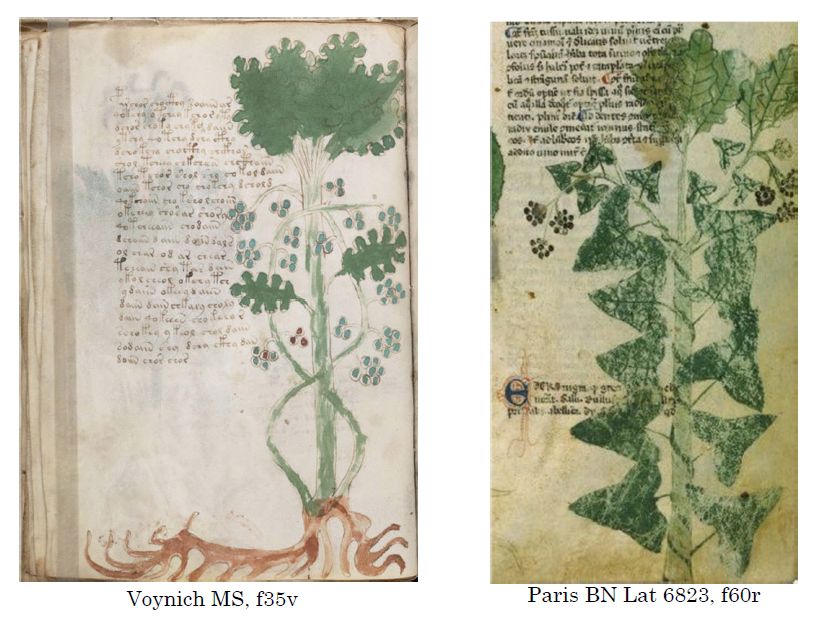
While the Voynich MS illustration clearly isn't a copy of the Paris MS, it is also inconceivable that it was not in some way inspired by this or a similar illustration in another MS.
The herbal section of the manuscript is the longest. It fills more than half its pages. As we shall see later, the text on these pages can be split into two parts, with two different handwriting styles and two different sets of statistical text properties (15). These are quite distinct and easily visible. Without going into any details at this point, they have led to the introduction of the 'A' and 'B' languages in the MS.
The style of plant drawings on these two sets are not obviously different, at least at first sight. However, in 2024 Koen Gheuens and Cary Rapaport undertook a detailed study of the herbal drawings, and came to the conclusion that there are a number of details that clearly identify plants as belonging to 'A' or 'B' language pages (16). Their results have been incorporated in the detailed pages descriptions at this web site.
Astronomical pages feature drawings that often have a sun or moon face in the centre, or arrangements of stars. It is sometimes hard to draw a clear line between astronomical and cosmological pages (for which see below). The twelve astronomical pages that have illustrations of the zodiac are usually called astrological pages (for which see also below).
One recognisable item in the astronomical pages are the Pleiades on f68r3, given that this is illustrated as a group of seven small stars very close to each other.
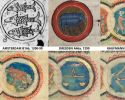
It has also been suggested by Newbold that f68v3 represents the Andromeda galaxy seen by Bacon through a telescope. This is, however, not realistic, and there is no need to invoke spiral galaxies and anachronistic technologies to explain this illustration. Several examples of similar spiral drawings, with different numbers of spirals going round in both directions, are found in an Armenian MS in the Schoenberg collection (LJS 443) from around 1420 (17):
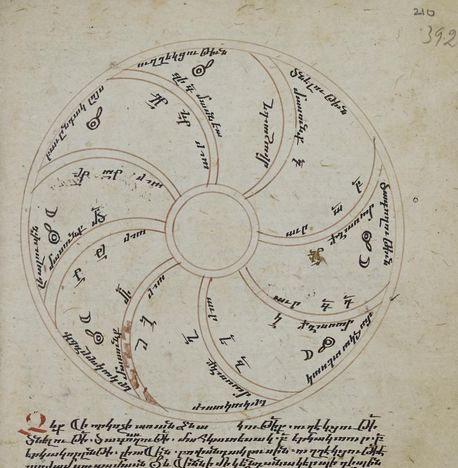
This folio (f68v3) is further discussed under the heading of cosmological illustrations.
Cosmological pages feature geometric designs, all essentially circular, which cannot be easily classified. The use of the term 'cosmological' for these pages was first introduced in Newbold (1928) (18). While some of these appear unique, others are quite similar to cosmological illustrations found in other medieval manuscripts, which relate to the months of the year, the zodiac, or the winds. Some examples of these were shown by E. Velenska, in her now lost blog:
There is one very large composite drawing on a six-page fold-out consisting of nine connecting circles with four smaller items on the corners. This is usually called the 'Rosettes' page. It includes innumerable details, among others with several illustrations of buildings, one reminiscent of a N.Italian castle. It was shown already on the page about the origin of the MS. The central circle includes six tower-like structures supporting a plane filled with stars (the sky?). Many people have considered that this drawing represents a map, and there is a considerable amount of discussion about this on various internet resources (see note 1).
The zodiac pages contain concentric circles with usually 30 small, mostly feminine figures (nymphs) holding stars, and an emblem of a zodiac sign in the centre. These nymphs are very similar to those drawn in the biological section (see below). There is a (possibly relevant) precedent for such nymphs in a Byzantine astronomical MS in the Vatican Library.
The zodiac does not start with Aries, but with Pisces, which is very unusual. The next two signs, Aries and Taurus are both represented in two illustations with 15 nymphs each. The illustrations for Capricorn and Aquarius are missing, but there is a missing folio (f74) exactly at the point where they should have appeared.
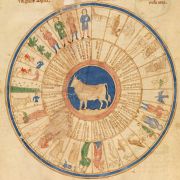
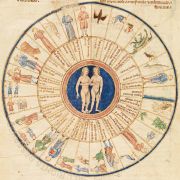
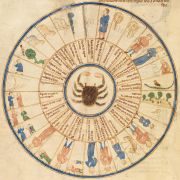
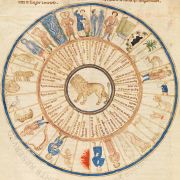
The presentation of these illustations appears related to paranatellonta, a term used for astrology based on the degrees of the zodiac (of which there are 30 per sign). Illustrations related to paranatellonta are found (among many others) in the Vatican MS Reg.Lat.1283, some examples of which are shown below as thumbnails, with links to the orginal images at the Vatican digital library. Note that it is possible to navigate the entire MS from any of the image links.
| Taurus | Gemini | Cancer | Leo |
|---|---|---|---|
 |
 |
 |
 |
| >>image link | >>image link | >>image link | >>image link |
The zodiac illustrations are the most recognisable in the MS, and allow comparison with illustrations of zodiac cycles in other MSs. An expert opinion on these illustrations was already cited in 2001 by Rafal Prinke, who obtained the following comment from Prof. Ewa Sniezynska-Stolot of the Jagiellonian University in Cracow, who is an expert in the history of art in general and in astrological iconography in particular:
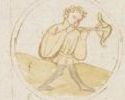
I have inspected the VMS at Beinecke. The signs of the Zodiac do not present problems - they are simply not of the Arateia type but were modernized. As I wrote in my books, because of linguistic mistakes and changes in artistic styles, human figures were represented in contemporary garments (viz. Gemini, Virgo, Sagittarius). Attributes were changed in the same way, eg. Sagittarius' bow developed into a crossbow in the 15th c.
The genre scenes, eg. Aries eating a bush, suggest that the signs were redrawn from a calendar. Garments: the jopulas of men with a belt suggest the 14th/15th c. but headdresses of men (Gemini, Sagittarius) definitively indicate the 15th c. This was common fashion in Europe at that time. The Sagittarius' cap with fox tail points to Germany - but they were also worn in Poland. I believe that the manuscript can be dated to mid-15th c. From the astrological iconography point of view, the Taurus at a well is somewhat strange - unless an image of donkeys was a basis for it and then it would refer to Cancer - but that is certainly going too far.
In my opinion it is a notebook of a liberal arts student. Similar notebooks are Beinecke 225 and 226 (19). The former belonged to Paul de Worczin who studied in Cracow in 1422. [...] The latter is also from Cracow.
In August 2016 I kindly received a reply from Prof. Dieter Blume, an authority on astronomical illustrations throughout the ages (20), in which he strongly confirmed the main aspects of the analysis of Prof. Stolot, and also pointed to the probable relevance of the MSs of Alfonso el Sabio, as also Erwin Panofsky had already done. One such MS was already shown above. He considered the representation in the Voynich MS quite ideosyncratic.
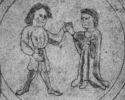
While the zodiac emblems are easily recognisable, in some cases they are somewhat unusual, as already pointed out by Prof.Sniezynska-Stolot. Several comparisons of the relatively unusual representations of some of the signs with other MSs have been published from end 2015 to beginning of 2016 in two blogs. These are well illustrated and very suggestive, and links are provided in the following table:
| About... | Source | |
|---|---|---|
 |
Sagittarius | >>Post
by M.Ponzi and D.Worley at the
blog of S.Bax
(21)
>>Post by J.K.Petersen at his own blog. |
 |
Gemini | >>Post by M.Ponzi and D.Worley at the blog of S.Bax |
 |
Scorpio | >>Post by J.K.Petersen at his own blog. |
 |
All signs | >> Comprehensive post by M.Ponzi at the blog of S.Bax |
The contributons related to the Sagitarius image show that such illustrations may be found in German MSs written between (roughly) 1400 and 1500. Very unusual Scorpio's (i.e. not looking like a scorpion) may be found in different areas of central and northern Europe, though a very close match has not yet been found. The large-scale comparison of the entire zodiac cycle in the Voynich MS - to the extent that it is available - with well over 100 cycles in other MSs, further confirms the closest similarity of the Voynich MS zodiac cycle with several MSs from Southern Germany.
The following section of the Voynich MS has traditionally been called the biological section, though others prefer to call it the balneological section. D'Imperio qualifies it as the most unusual part of the Voynich MS.
It contains drawings of so-called nymphs, similar to the ones mentioned above in the zodiac section, populating arrangements of pipes or vessels, and what seem like baths or clouds. Many illustrations leave the impression of representing a chemical (alchemical) or natural process. They have also been compared to organs in the human body.
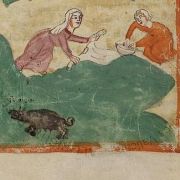
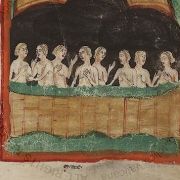
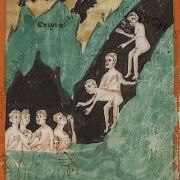
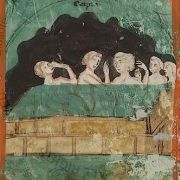
Several people have, independently from each other, pointed out a resemblance of these illustrations with the MSs of the Balneis Puteolanis, a description of some medicinal baths written in the 13th Century (22). This has led to the introduction of the term balneological for this section. There is also a suggestion that this section really consists of two parts that have become mixed during a (re-)binding of the MS (23). The following shows some illustrations of a MS copy of the Balneis Puteolanis now preserved in the Vatican library (24), in which all water is painted in green, as is mostly the case in the Voynich MS. Again it is possible to navigate the entire MS from any of the image links.
| f30r | f36r | f40r | f46r |
|---|---|---|---|
 |
 |
 |
 |
| >>image link | >>image link | >>image link | >>image link |
An interesting piece of evidence that suggests that the present binding of this part of the MS may not be as originally intended, is the fact that the illustrations on f78v and f81r form one connecting design, with water flowing from the left part into the right part. Presently, another bifolium is bound in front of this one, and the combined design is invisible.
Most of the objects held by people, as listed below, are found in the biological section. In some of the MS copies of the Balneis Puteolanis one may also find some objects that might explain the purpose of these (bellows, a bag to perform enema).
The so-called pharmaceutical section consists of three very similar bifolios that are, however, not all bound together in the MS. Each of the bifolios has foldout sheets and they all have a very similar layout. On the left side of each page are objects that look like containers. Arranged to the right of these containers are arrays of small herbal drawings. Most of these do not present complete herbs, but only leaves or roots. They have varying sizes. This section is not similar to any other herbal MS that I am aware of. On the other hand, it is not at all unusual for herbal manuscripts to include drawings of a quality and size similar to this.
Th.Petersen already noticed that, in a number of cases, the herb drawings in this section are clearly copies of (parts of) herbal drawings in the MS. This comparison has been followed up by several others, most recently by Mark Knowles of Oxford, who made quite a comprehensive list, also including many tentative cases. A minor effort was undertaken by several people to achieve a more objective list. The most promising cases have been indicated in the page descriptions of this web site.
Just to cite one example, the drawings on f37v and item 203 in the lower left corner of f102r1 undoubtedly represent the same plant, and were most likely copied from each other or from a common original drawing.
The containers appear in largely two forms. They are either composed of two or three cylindrical sections getting narrower towards the top, or have a more complicated form. Some of them appear empty, others appear to contain some liquid which has been painted with various colours. Others have a lid. Some of them have feet. A few of the most simple containers have also been likened to early microscopes (25).
It is possible to rearrange the three pharmaceutical bifolios such that the shapes of the containers form a gradually evolving sequence from simplest to most elaborate. This sequence is:
In this case the two bifolios of quire 19 would not be nested as they are now.
This part of the MS appears unfinished. The pharmaceutical folios have not been bound together in the MS. They are included in two quires. The two bifolios in quire 19 have simpler, largely cylindrical containers, which, on the last folio, gradually evolve into a more elaborate style. This elaborate style is continued on the one pharmaceutical bifolio in the earlier quire 15. An interesting comparison is provided by the following illustration, showing an object with some similarity to some of the containers in this section (26):
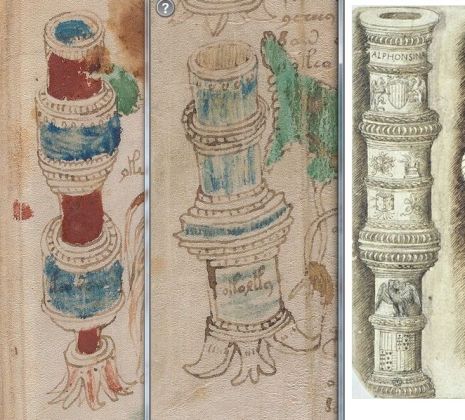
While this is representing a cannon, which would not make much sense in this context, many drawing details are comparable. One can also observe that the artist of the Voynich MS was far less experienced in representing a 3-dimensional object.
The mostly small parts of herbs are aligned in rows next to the containers, usually one row per container, but occasionally also two. In total there are 57 rows of herbs. Th.Petersen numbered all fragments in his hand transcription and arrived at 241 of them, though he seems to have counted two too many. These row and fragment numbers are used in the detailed descriptions of the pharmaceutical pages.
The supposed pepper identification of O'Neill is included in the pharmaceutical section, in the upper right corner of f100r.
At the end of the MS there are 23 pages filled with text, with stars drawn in the margin. This is commonly called the recipes section. These stars are similar in style to those that have been drawn in the zodiac section. They come in different types: the number of points is usually 7 or 8. Some are painted red, and some have a red or faded yellow centre. Some have a dot in ink in the centre. On all folios except the bifolio consisting of folios 103 and 116 the stars have tails. One other folio much earlier in the MS: f58 in quire 8 has a similar lack of other illustrations, and a few stars in the margin both on the recto and verso side.
In the recipes section, most of the time there is one star in the margin for each of the short paragraphs of text. On two folios (f108v and f111, both sides) there are larger sections of running text, but the stars still appear in the margin with the same distance as usual. f116r has some runing text with stars, and some without. There is one short paragraph on f106r where the star in the margin has a small companion star.
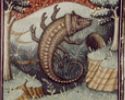
The roots of some herbs have an animal-like appearance, such as:
And of course several zodiac signs are represented by animals.
Some pages contain a circle subdivided into two halves, with one half further split into two quarters. This design is very similar to a medieval stylized world map referred to as a T-O map. The three sections of the T-O map refer to the continents of Europe, Asia and Africa. These maps may be seen on the following pages:
The Voynich MS contains very few recognisable Christian symbols (indeed, there are few recognisable symbols from any known religion). The only apparent example is on f79v, where the woman in the top left of the picture holds a cross.
There are over 500 small human figures in the MS, mostly female, and a number of them hold objects in their hands. Some of these seem identifiable (flowers, rings), but others not. Following is a list, which does not include the several hundred stars held by the zodiac nymphs.
Some of the following items appear like doodles, while others are quite unclear. This list is likely to be incomplete.
In the absence of evidence to the contrary, one is allowed to assume that, if the Voynich MS contains meaningful text, this text relates to the illustrations. Some examples of how this may help in the decipherment of the MS are given below.
|
|
|
|
|
|
|
|
|
|